
Mobile App Development
Mobile App Costs: Development and Maintenance
Estimate mobile app costs by scope, design, backend, integrations, testing and maintenance. Compare proposals against the same requirements.
Updated: 2026-10-20
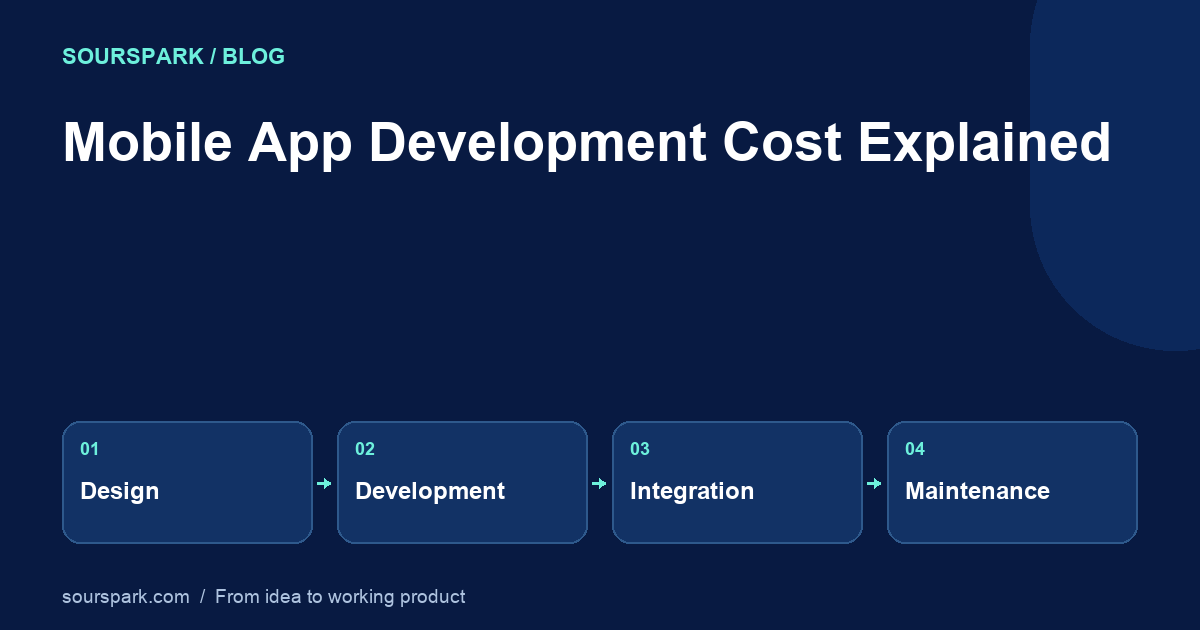
How do you estimate the cost of a mobile app?
There is no single fixed price for every app. Define the work first, then estimate effort and the relevant team rates for each work package. Budget hosting, external services and maintenance separately. Two apps with the same number of screens can cost very different amounts because of their security, data and integration requirements.
- Separate discovery, design and mobile development.
- Include the backend, administration and integrations.
- Account for device testing and store preparation.
- Distinguish recurring service costs from maintenance work.
- Clarify source ownership, accounts and handover conditions.

Compare the same scope
An app name is not enough for a useful estimate. Two booking screens may look identical while one submits a form and the other manages inventory, payments, cancellations and refunds. The cost reflects those promises, not just the visible interface.
Describe user roles, core journeys, device targets and external services. Ask every supplier to estimate against the same document so that a lower quote can be evaluated against the actual deliverables.
Separate the work packages
Break the estimate into discovery and design, mobile implementation, backend and admin, integrations, and verification and release. Give each package an acceptance condition. A payment integration should describe failures and restoration as well as the purchase screen.
Combine effort estimates with the relevant team rates. Show unresolved assumptions separately. A contingency should reflect known uncertainty rather than being presented as a universal price formula.
Separate a free demo from operating costs
A free prototype tool does not make production free. Hosting, domains, email, maps, notifications, AI calls and developer accounts can introduce recurring or usage-based costs. Check current provider pricing when preparing the estimate.
For an AI feature, model request frequency and output size per user. Prepare low, expected and high usage scenarios. These make assumptions reviewable; they do not guarantee future bills or revenue.
Define ownership and maintenance
Specify source access, developer-account ownership, signing-material handover and the defect-fixing period. Decide how operating-system upgrades and feature requests will be handled.
If the budget is tight, validate the riskiest dependency with a small prototype and reduce optional features. Preserve the core safeguards against lost data and unauthorized access. A modest product with a clear maintenance agreement is easier to evaluate than an expansive promise.
What does app maintenance include after launch?
Track service bills separately from maintenance work. Operating system and SDK updates, device testing, security fixes and issue monitoring require ongoing effort. Agree who handles each task and on what terms before accepting a proposal. Model usage-dependent services with low, expected and high usage scenarios rather than treating the first month’s bill as permanent.
Frequently asked questions
Is there one fixed price for an app?
No universal figure captures scope, integration complexity and verification effort. Compare estimates using the same acceptance conditions.
Does AI make development free?
Code generation may speed up some tasks. Design, verification, external services and ongoing maintenance still require resources.
SourSpark
Define the scope of your first release.
Share the audience, core journey and technical uncertainties so we can discuss a practical starting plan.
Tell us about your project